Lupine Publishers | Open access Journal of Complimentary and Alternative Medicine
Background: Despite recent developments in intensive care for patients with Traumatic brain injury (TBI), the long-term
neurological disabilities still exist. MLC901 is Traditional Chinese Medicine and has shown some neuroprotective and neuro
regenerative benefits after brain injury in previous animal and human studies and may provide a new therapeutic approach in the
treatment of TBI. Accordingly, we conducted this pilot, randomized, double-masked, placebo-controlled study to investigate the
efficacy of MLC901 in patients with moderate to severe TBI.
Materials and Methods: Patients with a diagnosis of moderate
to severe TBI were enrolled. Subjects were randomly assigned
to receive either MLC901 or placebo capsules three times per day over 6
months. Evaluation of patients was carried out at baseline,
3rd month and 6th month follow-after injury. Modified Rankin Scale (mRS)
and Glasgow outcome scale (GOS) were used to examine
patients. Efficacy was evaluated by comparing these two scores between
the 2 groups at follow-up visits.
Results: Eighty-one patients complete 6 months follow up.
There was no significant difference between two study groups
regarding the demographic features, interval between injury and start of
intervention and length of ICU stay. However, functional
outcome scales of GOS, MRS at 3rd and 6th month post-injury were
significantly better in MLC901 group compared to placebo
(p<0.05).
Conclusion: MLC901 has shown promising efficacy in patients suffering from moderate to severe TBI.
Keywords: NeuroAid, MLC901; Traumatic brain injury; Placebo-controlled study, Modified rankin scale, Glasgow outcome scale,
Functional outcome
Introduction
Traumatic brain injury (TBI) has significant morbidity, mortality
and is the major cause of disability in individuals younger than 35
years in the Europe and the USA. Traumatic brain injury (TBI) is also
one of the causes of epilepsy and a substantial proportion of traumatic
deaths are related to TBI [1]. TBI with its large socioeconomic
consequences and its high incidence in young adults is still an
important health concern worldwide and poses a real challenge
to public health. Despite recent developments in intensive care for
patients with TBI, long-term neurological disabilities related to TBI
still exist. More than half of patients show significant after-effects,
principally in cognitive tasks. Neuroprotective therapeutic Studies
have still not introduced safe, and effective treatment for TBI
[2,3]. MLC901 (Neuro Aid) as Traditional Chinese Medicine could
provide a new therapeutic approach in the treatment of TBI.
Therapeutic advantages of MLC901 have already been depicted in
patients suffering from stroke, Alzheimer’s disease, mild cognitive
impairment and vascular dementia [4-6]. Consistent with findings
of clinical reports in efficacy and safety of MLC901, animal studies
have also established that MLC901 prevents the death of neuronal
tissues, decreases cognitive dysfunction and also improves
functional neurological outcome by restoring neuronal circuits
in models of ischemia. MLC901has also shown neuroprotective
and neurorestorative actions, which could potentially lead to
the enhanced recovery of cognitive functions in animal models
of TBI. The efficacy of MLC901 has also been shown the oxygenglucose
deprivation model, which mimics ischemic conditions
[7,8]. Additionally, in a recent study, MLC901 has demonstrated to
improve cognitive functioning in patients with mild to moderate
TBI [9]. In this study, we aimed to evaluate the effect of MLC901
on neurological function and outcome in patients suffering from
moderate to severe TBI.
Materials and Methods
Study design and patients
This was a randomized, double-blind, Placebo-controlled,
study conducted between May 2017 and December 2019.
The aim of the study was to determine efficacy of MLC901 on
neurological outcome after injury in patients with moderate or
severe TBI. Clinicians recruited patients from University-affiliated
hospitals and patients were eligible for this study if they satisfied
the following inclusion criteria: age between 15 and 65, nonpenetrating
moderate (Glasgow Coma Scale score [GCS] 9-12) or
severe (GCS 3-8) traumatic brain injury less than 24 hours from
traumatic injury, anticipated intensive care unit length of stay at
least 48 hours. Patients were excluded if GCS was 3 and they had
fixed dilated pupils or penetrating injury, coexisting injury or
medical conditions which could adversely affect our study outcome
measures, dependence for everyday activities before the injury,
pregnancy or breastfeeding, known allergy to any of MLC901
components.
MLC901 contains nine herbal components (0.114g radix
Paeoniae rubrae, 0.57g radix Astragali, 0.114g radix Salviae
miltiorrhizae, 0.114g rhizoma Chuanxiong
, 0.114g
radix Angelicae
sinensis, 0.114g
radix Polygalae, 0.114g
Prunus persica, 0.114g
Carthamus tinctorius, and 0.114g
rhizoma Acori tatarinowii) [10].
Patients were randomized to either MLC901 or placebo group
with a simple allocation ratio of 1:1. Randomization was stratified
based on age, gender, baseline and GCS. Patients received either
MLC901 or visually indistinguishable placebo capsules (vegetable
capsules that filled by less than 2 grams of stevia sweetened
powder) for 6 months supply. The dose was two capsules (0.4g/
capsule) taken orally three times per day for 6 months. Patients
were evaluated 3 month and 6 months after treatment initiation.
Outcome measures
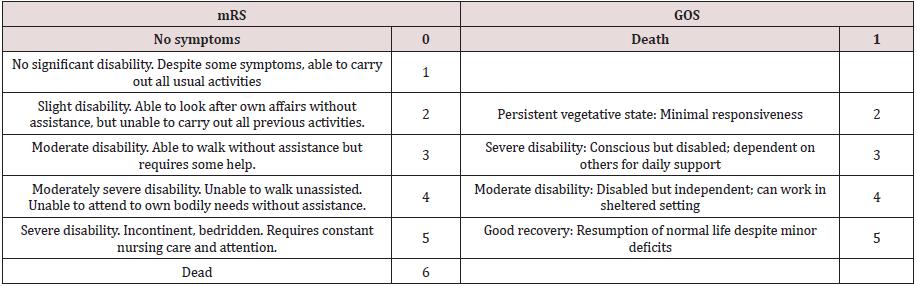
Modified Rankin Scale (mRS) and Glasgow outcome scale (GOS)
were utilized to examine participants at the baseline, 3 and 6-month
follow-up visits. mRS is a widely used scale to determine the level of
disability in patients with neurological disorders. It ranges between
0 and 6 with a higher score indicating a higher degree of disability
[11] (Table 1). GOS is also another commonly used scale to evaluate
patients with brain injuries such as TBI. This scale ranges between
1 and 5 with the highest score being the good recovery [12] (Table
1). All evaluations were conduct by medical staff who were unaware
about randomization of patients in each group.
Table 1: Modified Rankin Scale (mRS) and Glasgow Outcome Scale (GOS) subscales.
Statistical analysis
All statistical analysis was done by SPSS (version 16.0) software
[Statistical Procedures for Social Sciences; Chicago, Illinois,
USA] with the intention to treat approach. Descriptive data were
reported as a mean± standard deviation for Continuous values and
frequency for categorical values. Normal distributions of values
were determined by the Kolmogorov-Smirnov test. Non-parametric
data were compared using chi-square test. Kruskal-Wallis test was
used to compare parametric data without normal distribution
between two study groups. P values less than 0.05 were considered
a statistically significant.
Ethical issues
Ethic committee of Shahid Beheshti University of Medical
Science, Tehran, Iran approved all study protocols and written
consent provided by each patient’s legal surrogate according to
Helsinki Declaration and as permitted by local regulations. The
protocol has been registered (ClinicalTrials.gov ID: NCT04487275).
Patients who recovered with decision-making capacity were asked
to consent to continue participating in the study.
Results
Table 2: Baseline characteristics.

*Interval between injury and start of intervention.
ICU: intensive care unit.
Table 3: The modified Rankin Scale of patients with moderate and severe traumatic brain injury being treated with MLC901 vs.
placebo.

Table 4: The Glasgow Outcome Scale of patients with moderate and severe traumatic brain injury being treated with MLC901 vs.
placebo.

Figure 1: CONSORT flow diagram of the study.
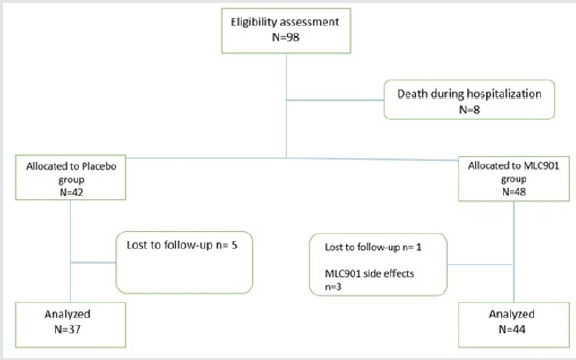
Totally 98 Patients recruited in this study. Seventeen patients
were excluded from the study due to occurrence of MLC901
side effect (n=3), loss of follow-up (n=6), and death during
hospitalization (n=8). The CONSORT flow diagram of the study is
demonstrated in figure 1. Baseline patients’ characteristics, interval
between injury and start of intervention, and length of intensive
care unit (ICU) stay in both groups were not significantly different
between the two study groups (Table 2). The comparison of mRS
and GOS scores between the two groups are depicted in Tables 3
& 4.
Discussion
Our primary findings provide evidence that MLC901 helps in
the recovery of patients with moderate to severe TBI. There were
significant differences between the two groups in mRS and GOS
scores at follow-up visits. Improvement of these two scales suggests
the potential usefulness of MLC901 at 6 months period after injury.
The brain is highly plastic following TBI and improvement in
function can be observed over a year after initial injury, therefore,
initiation of MLC901 during natural recovery period can facilitate
this process. In our study, MLC901 was given within first 24 hours
after TBI and it is likely that anti-inflammation and antioxidant
properties of MLC901 have affected recovery in its initial phase and
current evidence suggest the efficacy of these properties over the
first-year post-injury [13,14].
Various studies showed effect of different medication on TBI
based on mRS and GOS scores. Farzanegan et al, showed that,
functional outcome scales of GOS, mRS and at 3-months post-injury
were significantly better in patients with TBI who used atorvastatin
in compare to placebo group [15]. In another study by Khalili et
al, 3-months assessment of outcome by mRS and GOS showed no
significant different in patients who received glibenclamide in
compare with placebo group [16]. To the best of our knowledge,
this is the first study evaluating the efficacy of MLC901 in moderate
to severe TBI, consequently direct comparison of our findings to
previous studies is not possible. However, there is one study that
has reported the efficacy of MLC901 in mild to moderate TBI. In the
study by Theadon et al, authors evaluated the efficacy of MLC901 on
cognition in 78 patients suffering from mild to moderate TBI over 9
months and they used multiple questionnaires and scales to assess
participants in 1 to 12 months after TBI. They reported significant
improvements in complex attention and executive functioning.
They also found that MLC901 has no advantage over placebo
in terms of neurobehavioral sequelae, mood, fatigue, physical
disability or overall quality of life. No serious adverse events were
also reported [9]. Their findings are partially in line with the results
of a current study in this way that MLC901 is an effective therapy
for TBI regardless of its severity.
It is now well accepted that the functional recovery that occurs
spontaneously after brain injury (stroke or TBI) is due to the
plasticity of surviving neurons, lesion-induced plasticity, and/or
plasticity of neural connections [17,18]. In the other hand, overall
cellular remodeling that occurs after traumatic brain injury results
to proliferation of newly generated cells [19]. Although there is
a lack of clinical studies, experimental studies on TBI shows that
both gliogenesis and neurogenesis induced by MLC901, probably
help in inducing a dynamic brain remodeling and lead to a better
neurologic recovery in the first weeks after TBI [18,19]. In animal
model studies, Quintard et al. evaluated the neuroprotective and
neuro regenerative effects of MLC901 in a rat model of TBI. In their
study MLC901 inhibited the increase of S-100 beta and neuronspecific
enolase in serum, that are possible predictor markers of
neurologic outcome in patients with TBI. Also, they showed that
probably regulation of aquaporin 4 by injection of MLC901 2 hour
after TBI resulted to infarct volume reduction, prevented edema
formation and assisted its resolution [20]. In addition, recently
animal studies on focal and global ischemia have approved effects
of MLC901 in increased neurogenesis, neurite outgrowth, axonal
sprouting, dendritic arborization and/or synaptogenesis that are
correlated with functional recovery [7,21].
Neuroprotective effects of MLC901 in ischemic brain injuries was
suggested through activation of Toll-like receptor 4 (TLR4) signaling
and inhibition of the expression of Prx6 and the transcriptional
activity of NFκB which are main pathway in the immune system
response to injury [10]. Quintard et al, also reported that in animal
models of TBI, MLC901 effect around the lesion included vascular
endothelial growth factor (VEGF) upregulation, hippocampal
neurogenesis and gliogenesis [20]. Brain-derived neurotrophic
factor (BDNF)and VEGF are well-known growth promoting
factors that play a key role to support adaptive remodeling of
surviving neurons and neural networks modulation in recovery
process [22,23]. VEGF is an important tissue repair mediator after
brain injury and has substantial role in angiogenesis [24]. In the
other hand BDNF upregulation by MLC901 has been reported in
brain injuries due to stroke and cardiac arrest [7,22,25]. It seems
that increased expression of VEGF and BDNF is another positive
effect of MLC901 that could be responsible for the findings that
observed in this study.
The combination of multiple herbal components is thought to maximize
therapeutic efficacy by facilitating synergistic actions and
ameliorating or preventing potential adverse effects while at the same
time aiming at multiple targets [22]. In the neuroinflammation study by
Widman and Heurteaux list assumptions of molecules which may explain
part of the effects [10,22]. In these different herbs that are extracted
to manufacture MLC901, there are a number of recognized molecules such
as ferulic acid ferulic acid (Radix angelicae sinensis, Rhizoma chuanxiong) [26], salvianolic acid B and tanshinone IIB (Radix salvia miltiorrhizae) [27-28] tetramethylpyrazine (Rhizoma chuanxiong) [29-30], ligustilide and butylidenephtalide (Radix angelicae sinensis, Rhizoma chuanxiong) [31-32], astralagoside IV (Radix astragali) [33], ligustilide and butylidenephtalide (Radix angelicae Sinensis, salvianolic acid B and tanshinone IIB (Radix salvia miltiorrhizae) that are identified for neurobeneficial and anti-inflammatory activity [10,23].
There are several strengths as well as limitations to our study.
Recruitments of patients were challenging since their surrogates or
patients mentioned taking capsules three times daily over 6 months
as a hurdle to participate in the study and some suspect this many
capsules could harm patients rather than help them in recovery.
Probably, decreasing the daily dosage administration would help in
participation and adherence of patients. Additionally, moderate to
severe TBI is known to be related to cognitive deficits, therefore,
aids to support memory may increase patient’s adherence and
compliance. We used GOS to assess patient’s outcome. Recently
is suggested that Glasgow Outcome Scale-Extended (GOSE) has
priority to the GOS. GOSE in extended version of GOS that improve
sensitivity of minor changes detection in functional activity [34].
Our study also suffers from a limited number of patients. Lack of
patients self-reporting questionnaire is another issue with this study.
We didn’t measure any neuroplasticity biomarkers in our patients,
but it seems that measuring the neuroplasticity biomarkers in
future studies could be useful to understand the underlying effects
of MLC901 in TBI. We suggest, with the current promising result of
the present study, more studies with a larger group of patients with
different evaluation scales and longer duration of follow-up should
be performed to draw a better conclusion.
Conclusion
This work provides evidence that MLC901 is an effective
therapeutic approach in patients suffering from moderate to
severe TBI. However further studies with more clinical and paraclinical
assessments are suggested to evaluate different aspects of
MLC901effectiveness in neurologic disease and particularly TBI.
Acknowledgments
None.
Conflict of Interest
None.
Follow on Twitter: https://twitter.com/lupine_online
https://lupinepublishers.com/complementary-alternative-medicine-journal/fulltext/mlc901-for-moderate-to-severe-traumatic-brain-injury-pilot-randomized-double-masked.Id.000148.php

