Alstonia scholaris Linn is popularly known as the “Chatim” or the
Devil tree, which are used as a well-known remedy for the
treatment of various types of disorders in the Ayurvedic, Homoeopathic
and Folklore system of medicine in Bangladesh, India
and many others countries. Alstonia scholaris is mainly used for the
treatment of diarrhoea and malaria as a tonic, febrifuge,
emmenagogue, anticholeric and vulnerary. Considering the medical
importance and source of origin, the plant Alstonia scholaris
has been subjected for fractionation with different solvents. The
different fractions of ethanolic extract of Alstonia scholaris were
evaluated for antioxidant activity as well as biological activity.
Phytochemical properties of leaves of Alstonia scholaris were also
investigated. The different solvent fractions showed the presence of
tannins, glycosides, steroids, and alkaloids. The different
fractions of ethanolic extract of Alstonia scholaris were evaluated for
the total phenolic content, total flavonoid content, reducing
power capacity, total antioxidant activity and DPPH radical scavenging
activity. From the result on the various antioxidant activity
tests, it was found that Dia-ion resin adsorbed fraction showed the
highest value, followed by petroleum ether fraction, ethyl acetate
fraction and chloroform fraction. Overall results of the antioxidant
evaluation and various biological screening tests were found
satisfactory and may encourage researcher to use this plant as a source
of potent antioxidant food material as well as bioactive toxic
compounds to be used in therapeutic drugs preparation.
Keywords: Phytochemistry; Antioxidant Activities; Alstonia scholaris; Chloroform
Introduction
Plant kingdom is a mysterious world of chemical compounds
and mainly organic compounds. The nature abounds in organic
compounds of every conceivable structural class. The cells of living
organisms, plants, fungi, other animals are the sites of complex biosynthetics
that result in the formation of many varieties of organic
compounds; many of them are of great importance to mankind [1].
This is why the modern world is interestingly tending to go back
to the pre- industrialized days, when the mankind used to depend
on the plant kingdom for their food, shelter, medicine, and other
essential commodities. This is perhaps, the only way to protect
the ecological balance. The raw materials of the plant kingdom as
mentioned above are directly or indirectly produced by the plants
but are very seldom used by themselves and serve human beings
in many ways. These are called the secondary metabolites or the
natural products [2]. By the metabolic activity of plants produces
not only the food materials so essential for sustenance of the life
of animals but also certain other substances, such as alkaloids,
vitamins, glycosides, toxalbumins, essential oils, resins, bitter
principles etc. which are necessary for growth, maintenance and
protection of life [3].
Many of these are essential for metabolic activities [4],
many are medicines to human and animal life. Many of these are
harmful to animal life, at least under certain conditions. Plants
containing medicinal properties are commonly known as medicinal
plants. The plants containing these principles are capable of
acting deleteriously, are popularly known as poisonous plants. A
poisonous plant is one which, as a whole or as a part thereof, under
all or certain conditions, and in a manner and in amount likely to
be taken or by brought into contact with an organism, ‘will exert
harmful effects or cause death either immediately or by reason
of cumulative action of the toxic property, due to the presence of
known or unknown chemical substances in it [5].
Although some of these plants are once poisons, medicines
and food or fodder. The genus Alstonia belongs to the family
Apocynaceae. It includes totally 43 species of which two species
namely, A. scholaris (L.) R. Br. and A. venenata R. Br. are represented
in South India [6]. These two species can be identified with their
habits, shape and texture of the leaves, fruit size and papilla of
the seeds The bark of Alstonia scholaris L is bitter, astringent,
acrid, thermogenic, digestive, laxative, anthelmintic, febrifuge,
antipyretic, depurative, galactogogue, stomachic, cardiotonic and
tonic [7]. When these plants are used in herbal formulations, their
botanical identity needs to be established beyond any ambiguity
[8]. It has been found an important medicinal plant and addressed
by scientist from various countries [9]. But in our country, this plant
has not been studied in detail till now. Plant constituents are found
different in quantity as well as in structure when collected from
different sources.
Methods and Materials
All the reagents and chemicals were used for the presence work
were purchased from THOMAS BAKER (MUMBAI, INDIA), BDH
(ENGLAND), FLUKA (SWITZERLAND) and E. MERCK (GERMANY).
Commercial alcohol (rectified spirit) and absolute alcohol
were available from Carew and company, Darsana, Chuadanga.
The Solvents used mainly in this work are benzene, acetone,
tetrahydrofuran (THF), ethyl acetate, chloroform, n-hexane,
petroleum ether, methanol, absolute alcohol, toluene etc. The
solvents were dried and distilled when necessary.
During the present work solvents were purified priors to
use by distillation at the boiling point at the respective solvents.
Evaporation of solvents from the extracts and other solutions were
carried out on a rotary evaporator under reduced pressure of bath
temperature not exceeding 40 °C. The purity of the compounds
were tasted by analytical thin layer chromatography (TLC) on
silica-gel plate and the Spots were made visible either by exposing
it under UV lamp or iodine vapour or by spraying with the some
suitable spray reagents, if it is not visible in the day light.
All evaporations were carried out under reduced pressure
using a Rotary Vacuum Evaporator (rotavapour) on water
bath temperature was not exceeding 40 °C. Smaller volume of
non-aqueous solvents were removed by keeping in open air.
Crystallization was employed as a final purification process. The
solvent was chosen in which the compound was least soluble. The
compound was dissolved in a minimum volume at a solvent in hot
condition and was left for crystallization. Sometimes mixture of
solvents was also used. The Alstonia scholaris plant leaves were
collected from the cultivated adjacent areas of BCSIR, Rajshahi. The
collected leaves were washed with water.
100g of fresh leaves were taken for the determination of
water content. Then the fresh leaves (100g) were dried at room
temperature and the dried leaves were weighted again and that was
37g. Therefore, the water content of the leaves of Alstonia scholaris
was calculated below:

Dried ground of Alstonia scholaris leaves (W1=1.5802g) were
heated at 105 °C until a constant weight was reached (W2 = 1.4562g)
and the moisture content was determined.
Moisture content =
= 7.84%
Dried ground Alstonia scholaris leaves contain 63% water
content and 7.84% moisture content. Thus, the dry matter of
Alstonia scholaris given below:
Dry matter = 100 – (63+ 7.84)= 29.16%
The collected materials were washed thoroughly in water,
chopped, air dried for a week at 35-40 °C and pulverized in electric
grinder. Dried ground leaves of Alstonia scholaris were exhaustively
extracted with ethanol (EtOH, Analytical Grade, BDH Laboratory
Supplies) in Soxhlet apparatus. The resulting juicy extract was
filtered through Whatman paper No.1 and concentrated under
reduced pressure at 45 °C using the Buchi Rotavapor R-200 to
obtain a crude residue (23.5%).The process have done for several
time to increase the crude extract. Then water triturate part was
collected from crude extract. The water triturate fraction was
passed through a previously well packed Dia-ion resin column
which has selectivity to collect only the phenolic group containing
compounds. Then the materials, which were bound in resin column,
collected by passing methanol solvent. Then Petroleum ether, Ethyl
acetate and Chloroform solvents were passing through the residue
respectively. Finally, Petroleum ether, Ethyl acetate and Chloroform
triturate were collected.
Total phenolic content of different extractives of Alstonia
scholaris were determined employing the method as described by
involving Folin-Ciocalteu reagent as oxidizing agent and Gallic acid
as standard [10].
Determination of Total Antioxidant Activity
1. 0.5mL of plant extract or standard of different
concentration solution was taken in a test tube.
2. 3mL of reaction mixture containing 0.6M sulphuric acid,
28mM sodium phosphate and 1% ammonium molybdate was
added into the test tube.
3. The test tube was incubated at 95 °C for 10 minutes to
complete the reaction.
4. Then the absorbance of the solution was measured at
695nm using a spectrophotometer against blank after cooling
at room temperature.
5. A typical blank solution contained 3mL reaction mixture
and the appropriate volume (300μL) of the same solvent used
for the sample, and it was incubated under the same conditions
as the rest of the sample’s solution.
Determination of Dpph Radical Scavenging Activity
1. 2mL of methanol solution of plant extract or standard at
different concentration was taken in a test tube.
2. 3mL of methanol solution of DPPH was added into the test
tube.
3. The test tube was incubated at room temperature for 30
minutes in dark place to complete the reaction.
4. Then the absorbance of the solution was measured at
517nm using a spectrophotometer against blank.
5. A typical blank solution contained all reagents except
plant extract or standard solution.
6. The percentage (%) of scavenging was calculated from the
following equation.
% of scavenging = {(Ao – A1)/Ao} X 100
Where,
Ao is the absorbance of the control and
A1 is the absorbance of the extract/ standard.
Then % of scavenging were plotted against concentration and
from the graph IC50 was calculated.
Results & Discussion
Phytochemical screening of crude ethanol and four subfractions
of the leaves of Alstonia scholaris Table 1.
Table 1: Phytochemical screening of crude ethanol and four sub-fractions of the leaves of Alstonia scholaris.

Here, + = Present in the mild amount, + + = Present in the moderate
amount, + + + = Present in the large amount, − = Not present.
Total phenolic content
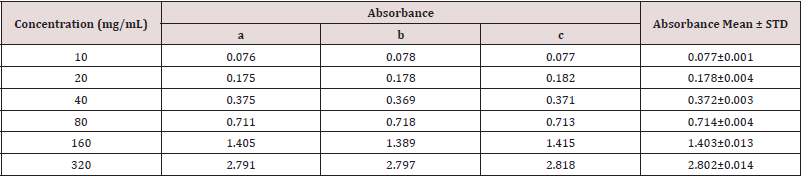
Absorbance of Gallic acid at different concentrations for the determination of total phenolic content (Table 2).
Table 2: Absorbance of Gallic acid at different concentrations for the determination of total phenolic content.
Determination of total phenolic content of different fractions of ethanolic extract of Alstonia scholaris (Table 3).
Table 3: Determination of total phenolic content of different fractions of ethanolic extract of Alstonia scholaris.
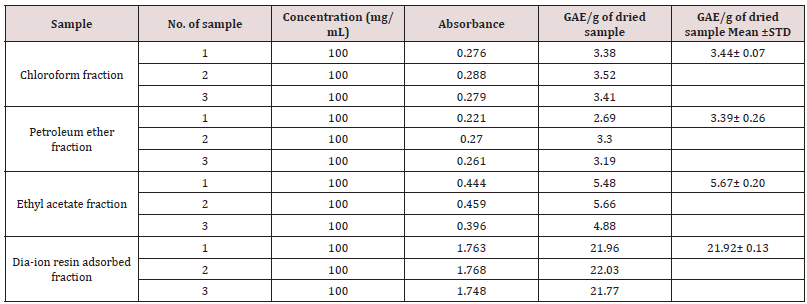
Total phenolic content of different fractions of Alstonia
scholaris were shown in Table 5 and Figure 2. Among the fraction,
the highest phenolic content was found in Dia-ion resin adsorbed
fraction (21.92± 0.13mg Gallic acid/g of extract), followed by ethyl
acetate fraction (5.67± 0.20mg Gallic acid/g of extract), Chloroform
fraction (3.44± 0.07mg Gallic acid/g of extract), and Petroleum
ether fraction (3.39± 0.26mg Gallic acid/g of extract) (Figure 1).
Table 4: Absorbance of catechin at different concentration for the determination of total flavonoids.
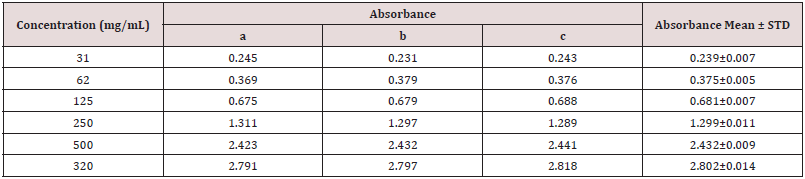
Table 5: Determination of total flavonoid content of different fractions of ethanolic extract of Alstonia scholaris.
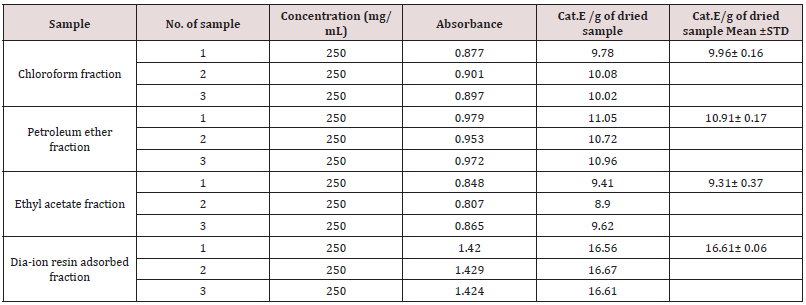
Figure 1: Total phenolic content (mg/g plant extract in gallic acid equivalent) of Alstonia scholaris.
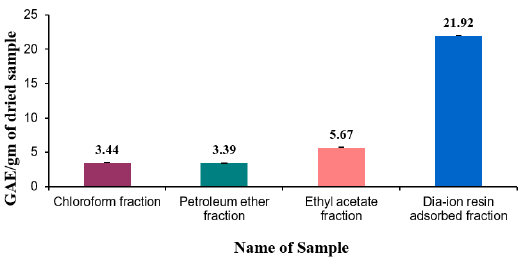
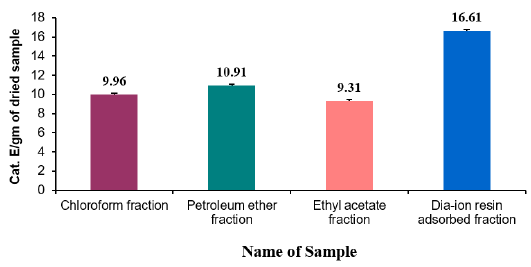
Figure 2: Total flavonoid content (mg/g plant extract in catechin equivalent) of Alstonia scholaris.
Total Flavonoid Content
Absorbance of catechin at different concentration for the determination of total flavonoids (Table 4).
Determination of total flavonoid content of different fractions of ethanolic extract of Alstonia scholaris (Table 5).
Total flavonoid content of different fractions of Alstonia
scholaris were show in Table 7 and Figure 2. Among the fraction,
the highest total flavonoid content was found in Dia-ion resin
adsorbed fraction (16.61± 0.06mg Catechin/g of extract), followed
by Petroleum ether fraction (10.91± 0.17mg Catechin/g of extract),
Chloroform fraction (9.96±0.16mg Catechin/g of extract), and Ethyl
acetate fraction (9.31±0.37mg Catechin/g of extract) (Figure 2).
Table 6: Reducing power capacity of different fractions of ethanolic extract of Alstonia scholaris and Ascorbic acid (standard) at
different concentrations.
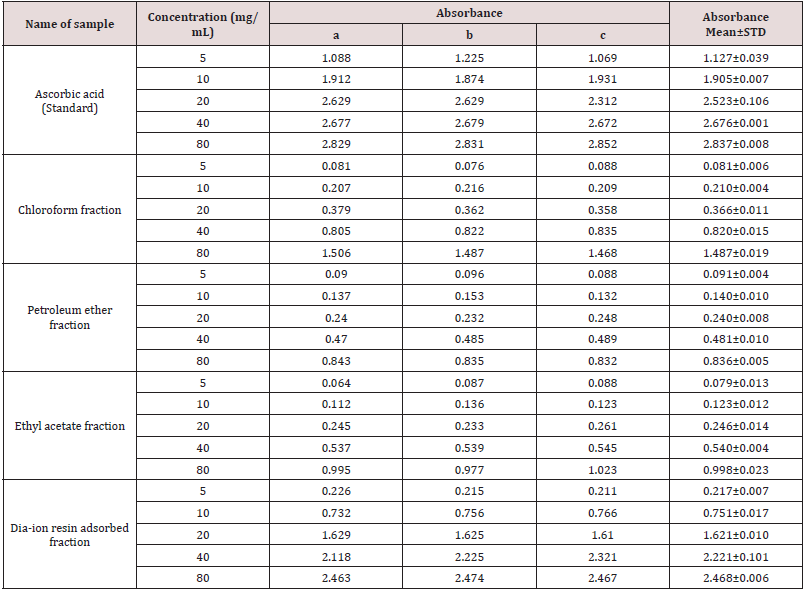
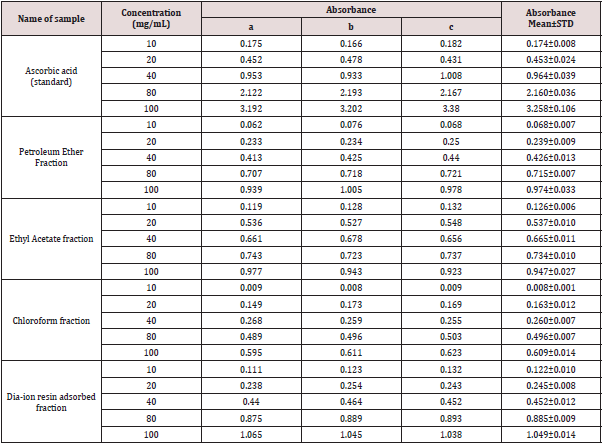
Table 7: Total antioxidant activity of different fractions of
Alstonia scholaris and Ascorbic acid (standard) at different
concentrations.
Reducing Power Capacity Content
Reducing power capacity of different fractions of ethanolic extract
of Alstonia scholaris and Ascorbic acid (standard) at different
concentrations (Table 6).
The iron reducing capacity of the four different fractions
of Alstonia scholaris extract such as petroleum ether fraction,
chloroform fraction ethyl acetate and Dia-ion resin adsorbed
fraction have been investigated. Among the four different
extractives Dia-ion resin adsorbed fraction showed the highest iron
reducing capacity with absorbance of 2.468±0.006 at 80μg/mL
concentration, followed by Chloroform fraction with absorbance
1.487±0.019 at 80μg/mL, while Ethyl acetate fraction showed iron
reducing capacity with absorbance of 0.998±0.023 at 80μg/mL and
Petroleum ether fraction showed the iron reducing capacity with
absorbance 0.836±0.005 at 80μg/mL (Figure 3).
Figure 3: Reducing power capacity of different fractions of ethanolic extract of Alstonia scholaris and Ascorbic acid (Standard).
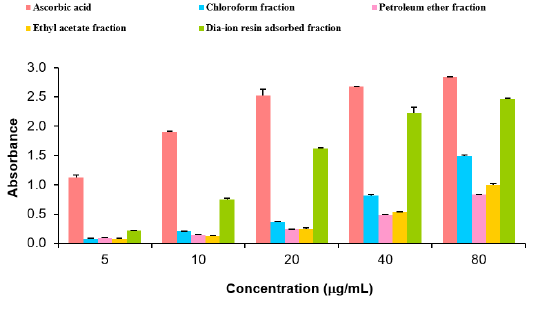
The reducing power of the different extractives and standard exhibited the following order:
Ascorbic acid> DRAF > CLF > EAF > PEF
Total Flavonoid Content
Total antioxidant activity of different fractions of Alstonia
scholaris and Ascorbic acid (standard) at different concentrations
(Table 7).
Total antioxidant activity of different fractions of ethanolic
extract of Alstonia scholaris such as Dia-ion resin adsorbed
fraction, chloroform fraction, Ethyl acetate fraction and petroleum
ether fraction were investigated. Among the fractions, Dia-ion
resin adsorbed fraction showed the highest total antioxidant
activity with absorbance 1.049±0.014 at 100μg/mL. Whereas
the Petroleum ether and Ethyl acetate fraction showed the
absorbance 0.974±0.033 at 100μg/mL and 0.947±0.027 at 100μg/
mL respectively. Chloroform fraction showed the lowest total
antioxidant activity with absorbance 0.609±0.014 at 100μg/mL
concentration (Figure 4).
Figure 4: Total antioxidant activity of different fractions of ethanolic extract of Alstonia scholaris and Ascorbic acid (Standard).
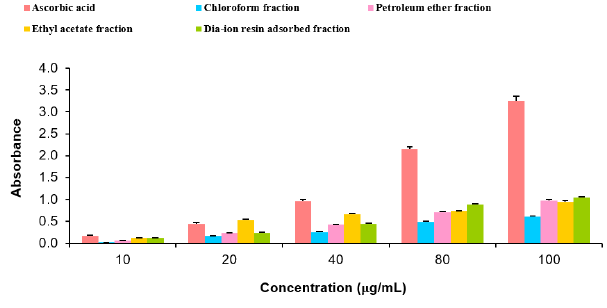
The total antioxidant activity of different extractives and
standard exhibited the following order:
Ascorbic acid> DRAF > PEF > EAF > CLF
DPPH Radical Scavenging Activity
DPPH radial scavenging activity of different fractions of
ethanolic extract of Alstonia scholaris and BHT (standard) at
different concentrations (Table 8).
Table 8: DPPH radial scavenging activity of different
fractions of ethanolic extract of Alstonia scholaris and BHT (standard)
at different
concentrations.
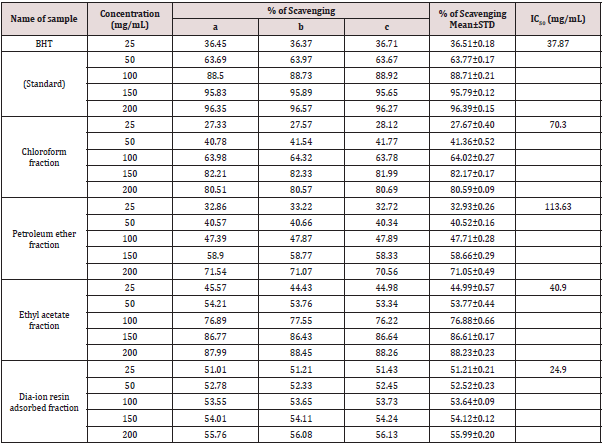
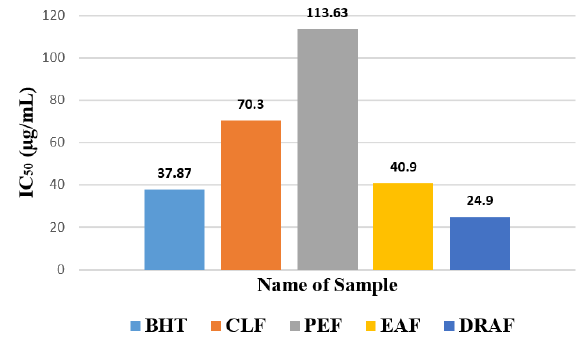
Among the fractions of the extract, highest DPPH radical
scavenging activity was found in Dia-ion resin adsorbed fraction
having IC50 value 24.90μg/mL. On the other hand, chloroform
fraction showed DPPH radical scavenging activity with IC50 value
73.30μg/mL, followed by ethyl acetate fraction with IC50 value
40.90μg/mL and petroleum ether fraction showed DPPH radical
scavenging activity with IC50 value 113.63μg/mL.
From the above results, we can conclude that, Dia-ion resin
adsorbed fraction shows the highest activity in Total phenolic
content, Total flavonoid content, Total antioxidant and DPPH radical
scavenging (Figure 5 & 6).
Figure 5: DPPH radical scavenging activity of different fractions of ethanolic extract of Alstonia scholaris and BHT (standard).
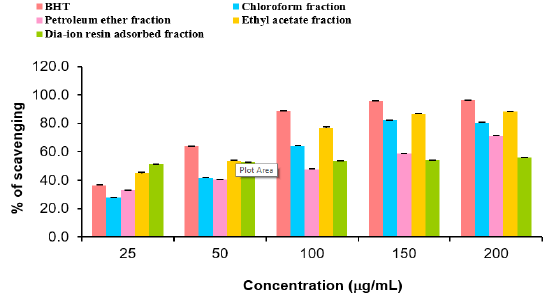
Figure 6: IC50 (g/ml) of different extractives of Alstonia scholaris for free redical scavenging activity by DPPH radical.
Conclusion
The present study investigated the plant Alstonia Scholaris
for antioxidant evaluation and biological activity of different
extractives. For this purpose, total phenolic content, total flavonoid
content, total antioxidant, DPPH radical scavenging activity tests
were performed with four different fractions of the plant. From the
results of the antioxidant activity test, it is clearly seen that Diaion
resin adsorbed fraction had the highest antioxidant activity.
Considering the antioxidant activities assay of A. scholaris, it can
be deduced that this plant contains useful potent bioactive toxic
compounds, which can be harnessed and purified into useful
therapeutic drugs. However, further studies are warranted for more
extensive antioxidant and biological evaluations to elucidate before
bringing them into commercial use.
Follow on Twitter: https://twitter.com/lupine_online
https://lupinepublishers.com/complementary-alternative-medicine-journal/fulltext/phytochemical-and-antioxidant-activities-of-different-fractional-extracts-of-alstonia-scholaris-linn.ID.000140.php